Search box

Brutal murder of a Mongolian beauty

Search This Blog

Thursday, March 12, 2009

Baggage too heavy for our new PM

MARCH 13 — Tunku Aziz | malaysianinsider

No one in living memory has ever had to drag so much unnecessary baggage along with him as Datuk Seri Najib Abdul Razak is doing on assuming the highest political office in Malaysia.

My heart naturally goes out to the unfortunate man who has had to fend off, without a break, a relentless barrage of poison-tipped arrows all aimed at his personal and public integrity.

I will not claim to know how he must feel because I would have absolutely no idea unless I were in his well-heeled shoes. And this would be most unlikely even in a million years.

Under different and happier circumstances, he should be celebrating his moment of destiny, the attainment, albeit Umno-style, of the greatest political prize of all.

However, I doubt, in spite of his calm and controlled demeanour and composure that he is looking forward to the great day with even the same degree of enthusiasm that I manage to wake up each morning for my breakfast.

Frankly I marvel at his ability to remain almost as unflappable (as the legendary Harold Macmillan, the British Tory prime minister of the “winds of change” fame) in such a difficult and dangerous situation. He would, in my book, rate an A+ for sang froid and panache.

For Najib, the saying “uneasy lies the head that wears the crown” seems entirely superfluous and irrelevant. Lucky you to be oblivious to the hostile world around.

Najib in the eyes of his detractors, and their numbers are legion, apparently has no redeeming feature at all which cannot be true because no human being is all bad.

However, the rumours about him that appear with such regular monotony on many blogs are unlikely to go away any time soon. The allegations are serious in the extreme, touching as they do upon his personal honour and integrity.

They will continue to dog and haunt him for as long as he holds public office. What a way to begin his stewardship of a troubled nation, a nation that seems to lack moral direction under the present government.

On present showing, his moral and ethical legitimacy to lead the nation is in serious doubt, and he must, for the sake of putting these malicious allegations to rest, once and for all, begin the process of suing those who have blackened his name and threatened his elevation to the office of prime minister of Malaysia.

This is the only way of clearing his name before the world. Nothing less than a full and open recourse to the justice system will suffice. The people of this country must not be shortchanged by having someone who has yet to clear his name in a court of law foisted on them.

They deserve better and Najib the new prime minister will then deservedly enjoy inestimable legitimacy and prestige in the eyes of the people of this country and the wider world.

Najib has all the positive qualities of leadership. He is literally and figuratively head and shoulders above the rest of the Umno stalwarts and it would be a pity if he chose to ignore the increasingly persistently strident collective voice for high moral and ethical standards in our political leaders.

It seems only fair that if Najib should feel unable for any reason to defend his honour and integrity in a court of law, then he will have to put up with more imputations of improper motives.

If he is not prepared, again for any reason, to put all of his actions under the closest public scrutiny, then he should reconsider his position. This is the ethical way forward, the only way, for anyone aspiring to the highest public office who harbours even the slightest doubt about his moral and ethical fitness for office. Yes, the standards expected are high, and the rewards are even higher. If you believe that you meet these expectations, then I wish you a long and successful stewardship of this nation, always I hope in the public interest.

Friday, March 6, 2009

The Sedition Act for Dummies

Friday, 06 March 2009 | RPK | Malaysiatoday

Actually, my case is very complicating indeed. The police report against me was that I was seditious because I had lied (di ada adakan). Therefore, should not the focus of my trial be on whether I did or did not lie? The government realises that this was a mistake so it is trying to amend the charge without officially amending it.

NO HOLDS BARRED

Raja Petra Kamarudin

I am currently on trial for the crime of sedition. It seems, according to Malaysia’s Sedition Act, I have committed a crime. The novel thing about the Sedition Act is that it does not matter whether I had lied or had told the truth. Even if I had not lied and had told the truth it would still tantamount to sedition. Therefore, I can go to jail for telling the truth if the government can prove that the truth I told is seditious. That is the fate that awaits me.

This means the court can block the truth from surfacing. I can’t use the truth as my defence. Therefore, I would not be allowed to adduce any evidence to support what I wrote or said. Never mind if I have evidence that so-and-so were the people behind the Altantuya murder or so-and-so were also present during the murder. This is not crucial to my defence and the court is not interested in seeing this evidence. The question would be: did I write or say what they allege I have written or said? If I did, then I am guilty. Whether I lied or not is not crucial to the charge and the court is not in the least interested in looking at whatever evidence I may have.

Now can you see why they chose to charge me under the Sedition Act as well as for criminal defamation for the second trial? This is so that the truth or falsity of what I wrote and said need not be argued. They only need to focus on whether I did it. This would mean the truth can forever remain suppressed and need never surface during the trial.

If they had instead charged me for making a false declaration or for signing a false Statutory Declaration, then I would need to prove I did not make a false declaration or had signed a false SD. So the truth of what I said and wrote would be very crucial. We would need to get to the bottom of things so that I can defend myself. The truth must be established so that we can prove I had not lied. Alas, this will not be the case because what I have been charged with does not require the truth to be established.

Actually, when they initially brought me in for interrogation, it was for the crime of making a false declaration. They probably realised that this would be suicide in the event I have the evidence to prove I did not make a false declaration. So they changed their mind and instead charged me under the Sedition Act as well as for criminal defamation. This would be safer as the truth of the matter need not be argued and can in fact be blocked from ever surfacing.

Let us look at what the Sedition Act is all about. This is actually a law from the time when the King was appointed by God and could do no wrong. To question the King is tantamount to questioning God and would therefore be an act of sedition. But those were in the days when the King could send you to your death. Today, the King is purely a Constitutional Monarch who does not possess the executive powers of the Kings of days gone by.

In Public Prosecutor vs. Param Cumaraswamy, the sedition charge against Param was:

That you on 24 July 1985 at about 11:00 a.m. at the office of the Selangor and Federal Territory Bar Committee in the old High Court Building, in the Federal Territory of Kuala Lumpur, uttered seditious words to wit, that part of your press statement as underlined, (the full text of which is attached as Sch. ‘A’ to this charge) and that you have thereby committed an offence under s 4(1)(b) of the Sedition Act, 1948 (Revised 1969) and punishable under s 4(1) of the said Act.

The judge in this case was Justice NH Chan, who has now become famous because of his opinion on the Perak Constitutional Crisis where he said that Pakatan Rakyat is on solid legal grounds.

Another case involved Marina Yusof who was alleged to have made a seditious statement during a DAP ceramah in Penang. Marina successfully proved she had not lied but they still found her guilty. This, as I said, is because the truth of the matter is not crucial to the charge. Even if she had told the truth, which was proven she did, she is still guilty.

Because of her age, the court decided to just fine her instead of sending her to jail. She paid the fine and went home. If she had not been over 60 and a grandmother to boot, they would have sent her to jail. And she was found guilty not because she had lied but because she told the truth. But the truth she told was considered seditious.

My defence in my sedition trial, therefore, becomes very dicey indeed. I can’t adduce whatever evidence I have. If I do, I will go to jail. Instead, I will have to allow them to prove that I committed the act. And if they can’t prove that then I will be home free. To admit that I committed the act by attempting to prove that I had not lied and by adducing the evidence I possess means I am confessing to a crime and would therefore lose my case.

Many are hoping that the evidence I have will surface during my trial. The government, however, is clever enough to make sure that it never will. And even if I am prepared to lose my case and risk going to jail by taking the line of defence that I may have done it but I did not lie, the court can still block this evidence as ‘not relevant’ to the case. They can bar me from adducing any evidence unless it involves proving I did not commit the act. If it is about whether I had told the truth or not, then the court does not want to see it.

Sir James Stephen’s definition of sedition found its way into the Criminal Code of the Gold Coast. Section 326 sub-s 8 of the Criminal Code of the Gold Coast, 1936 Revision, c 9, states as follows:

A ‘seditious intention’ is an intention:

(1) to bring into hatred or contempt or to excite disaffection against the person of His Majesty, His heirs or successors or the Government of the Gold Coast as by law established; or

(2) to bring about a change in the sovereignty of the Gold Coast; or

(3) to excite His Majesty’s subjects or inhabitants of the Gold Coast to attempt to procure the alteration, otherwise than by lawful means, of any other matter in the Gold Coast as by law established; or

(4) to bring into hatred or contempt or to excite disaffection against the administration of justice in the Gold Coast; or

(5) to raise discontent or disaffection amongst His Majesty’s subjects or inhabitants of the Gold Coast; or

(6) to promote feelings of ill-will and hostility between different classes of the population of the Gold Coast:

It is not a seditious intention if:

(a) to show that His Majesty has been misled or mistaken in any of his measures; or

(b) to point out errors or defects in the government or constitution of the Gold Coast as by law established or in legislation or in the administration of justice with a view to the reformation of such errors or defects; or

(c) to persuade His Majesty’s subjects or inhabitants of the Gold Coast to attempt to procure by lawful means the alteration of any matter in the Gold Coast as by law established other than that referred to in para (2) of this sub-section; or

(d) to point out with a view to their removal any matters which are producing or have a tendency to produce feelings of ill-will and enmity between different classes of the population of the Gold Coast.

Provided that none of the acts or things mentioned in provisos (a), (b), (c) and (d) shall be deemed to be lawful if they are done in such manner as to effect or be likely to effect any of the purposes (1) to (6) which are declared in this section to be a seditious intention.

‘Seditious words’ are words expressive of a seditious ‘intention’.

And what, you may ask, is ‘seditious intent’?

In both the Stephen and the Criminal Code of the Gold Coast definitions, an intention to achieve one or more of the objects specified in the definition is an essential ingredient of the crime of sedition. The important question is whether the “intention” must be proved. In article 94 of the Digest (4th Ed) Stephen put it thus:

In determining whether the intention with which any words were spoken, any document was published, or any agreement was made, was or was not seditious, every person must be deemed to intend the consequences, which would naturally follow from his conduct at the time and under the circumstances in which he so conducted himself.

In Wallace-Johnson v The King, counsel for the appellant contended (a) that both in English common law and in the Criminal Code in question there must be some evidence of intention outside the mere words of the instrument before a seditious intention can be said to exist; and (b) that in the present case, when the document is read, there cannot be found in it any seditious intention at all; and therefore before the appellant can be convicted there must be some evidence of seditious intention extrinsically, and, there being none, this conviction cannot stand on any ground.

3. (1) A ‘seditious tendency’ is a tendency:

(a) to bring into hatred or contempt or to excite disaffection against any Ruler or against any Government;

(b) to excite the subjects of any Ruler or the inhabitants of any territory governed by any Government to attempt to procure in the territory of the Ruler or governed by the Government, the alteration, otherwise than by lawful means, of any matter as by law established;

(c) to bring into hatred or contempt or to excite disaffection against the administration of justice in Malaysia or in any State;

(d) to raise discontent or disaffection amongst subjects of the Yang di-Pertuan Agong or of the Ruler of any State or amongst the inhabitants of Malaysia or of any State; or

(e) to promote feelings of ill-will and hostility between different races or classes of the population of Malaysia; or

(f) to question any matter, right, status, position, privilege, sovereignty or prerogative established or protected by the provisions of Pt III of the Federal Constitution or Article 152, 153 or 181 of the Federal Constitution.

(2) Notwithstanding anything in sub-sect. (1) an act, speech, words, publication or other thing shall not be deemed to be seditious by reason only that it has a tendency:

(a) to show that any Ruler has been misled or mistaken in any of his measures;

(b) to point out errors or defects in any Government or constitution as by law established (except in respect of any matter, right, status, position, privilege, sovereignty or prerogative referred to in para (f) of sub-s (1) otherwise than in relation to the implementation of any provision relating thereto) or in legislation or in the administration of justice with a view to the remedying of the errors or defects;

(c) except in respect of any matter, right, status, position, privilege, sovereignty or prerogative referred to in para (f) of sub-sect, (1):

(i) to persuade the subjects of any Rulers or the inhabitants of any territory governed by any Government to attempt to procure by lawful means the alteration of any matter in the territory of such Government as by law established; or

(ii) to point out, with a view to their removal, any matters producing or having a tendency to produce feelings of ill-will and enmity between different races or classes of the population of the Federation if the act, speech, words, publication or other thing has not otherwise in fact a seditious tendency.

(3) For the purpose of proving the commission of any offence against this Act the intention of the person charged at the time he did or attempted to do or made any preparation to do or conspired with any person to do any act or uttered any seditious words or printed, published, sold, offered for sale, distributed, reproduced or imported any publication or did any other thing shall be deemed to be irrelevant if in fact the act had, or would, if done, have had, or the words, publication or thing had a seditious tendency.

Actually, my case is very complicating indeed. The police report against me was that I was seditious because I had lied (di ada adakan). Therefore, should not the focus of my trial be on whether I did or did not lie? The government realises that this was a mistake so it is trying to amend the charge without officially amending it. In other words, they want the court to focus on the seditious act itself (whether I wrote the article) and not on whether the article is true of false (di ada adakan).

But what about the seditious tendency of the act I was alleged to have committed? And what if my intention, assuming I want to take the risk of admitting I wrote the article, was: to point out errors or defects in any Government or constitution as by law established or in legislation or in the administration of justice with a view to the remedying of the errors or defects? Well, then it will not be seditious in nature and I, therefore, have not committed any crime. But I will have to first admit I wrote that article to explain why I wrote it and this would mean they would be able to nail my balls to the wall.

Sigh…..damned if you admit it and damned if you don’t.

I think I will be a lawyer when I grow up.

Thursday, March 5, 2009

The truth that refuses to surface

Thursday, 05 March 2009 | RPK | Malaysiatoday
In my sedition trial, Superintendent Gan Tack Guan just refuses to reply to YB Gobind Singh Deo’s questions as to how and why Altantuya Shaaribuu was killed and whether someone had paid Azilah and Sirul to kill her. Gan also refuses to confirm whether C4 was used to blow up her body after she was killed. Gan, in fact, says it was not C4 and he does not know what type of explosive was used. Today, Malaysia Today will reveal the truth that Gan refuses to reveal in my trial.

THE CORRIDORS OF POWER

Raja Petra Kamarudin
The Altantuya Shaaribuu’s case: how and why she was killed
Published in the Liberation French newspaper on 5th March 2009

This is the English translation of the Liberation French article:

Shaaribuu Setev is a bitter and disappointed man. Yet, behind the saddened face of this Mongolian lies a fierce determination. Seated in a sofa in the lobby of an Ulaan Baataar hotel rattled by gushes of a freezing wind, this sixty years old man is ready to fight. His face features, hardened by the suffering and the stern climate, and his intense gaze tell all. “My daughter has been murdered by Malaysians on Malaysian territory. And they did not have even offer a word of apology,” states this professor of psychology at the National University of Mongolia.

The assassination of his daughter, Altantuya Shaaribuu, took place in October 2006. This was a murder unlike others in a region where business conflicts or petty politics are often settled with a gun. Everything in this case, which started in 2002 when the French Spanish company Armaris concluded the sale of three submarines to the Malaysian government for the amount of one billion Euros, is out of the ordinary.

The impact of the “Altantuya case” in France, Malaysia and Mongolia has yet to reach its climax. The murder of the 28 year old Mongolian was the result of a “commission” at the price of 114 million Euros by Armaris to its Malaysian counterpart. This “commission,” which was acknowledged by the Malaysian government in front of the Parliament in Kuala Lumpur, has triggered a chain of events that has led to the assassination of Altantuya and the disappearance of several key witnesses in the case.

A report from the Malaysian police, written on 19th november 2006 and which has been kept secret until now (can be read below), reveals dry and precise descriptions as to how this young woman, a member of Asian high society, has been killed. In this document, one of the killers, a policeman of the Malaysian Special Branch named Sirul Omar, replied to the questions of an officer at a police station close to the murder scene. “When the Chinese woman saw that I was taking a gun, she begged me to spare her, saying she was pregnant. Azilah (the commanding officer of Sirul) grabbed her and [threw] her on the ground. I immediately shot the left side of her face. Then Azilah took off her clothes and put them in a black plastic bag. Azilah noticed that her hand was still moving. He ordered me to shoot again, which I did”, said Sirul. This is the first confirmation of Altantuya’s assassins’ identity. “Then we carried her body into the woods. Azilah wrapped the explosives around her legs, her abdomen and her head, and we exploded her.”

The revelation of this report in the French newspaper Liberation is the latest chapter in this colourful and dramatic saga featuring French weapon sellers, Mongolian Shaman, and Malaysian politicians. This case is explosive not only for the Malaysian government, since the deputy Prime minister Najib Razak (who is scheduled to become Prime minister at the end of March) is suspected of having links to the case, but also because it could embarrass the DCNS, this French company specialising in military shipbuilding. The French Spanish company Armaris, which sold two Scorpène and one Agosta submarines to Malaysia in June 2002, was bought by DCNS in 2007.

With her magnetic beauty and sophistication, Altantuya is reminiscent of the troubling image of a Far East Mata Hari. She grew up in Saint Petersburg (Russia), then studied at the Institute of Economic Management in Beijing. Besides speaking English, she is fluent in Russian, Chinese and Korean. The fateful cycle for Altantuya came into gear when she met Abdul Razak Baginda in Hong Kong in 2004. Baginda is a security expert and the director of the Malaysian Strategic Research Centre, a pro-government think-tank. The two quickly became romantically involved. Altantuya, nicknamed Tuya by her friends, proved to be a useful assistant, helping Baginda translate from Russian to English.

Whereas Altantuya is young and beautiful, the rich and alluring Baginda is a well known figure of the Kuala Lumpur’s elite, notably because of his proximity to the Malaysian Deputy Prime minister and minister of Defense Najib Razak (he is also his security affairs adviser). Baginda parades in the most exclusive circles of Kuala Lumpur, sometimes accompanied by his legitimate wife.

In March 2005, Altantuya and Baginda departed for Europe, touring France, Germany, Italy and Portugal in the red Ferrari of Baginda, staying in posh hotels and dining in the finest restaurants of the old Continent. This trip, however, was not only for tourism: the contract for the sale of the submarines had been signed in 2002, but important details had yet to be settled. “We knew that Baginda was used by Deputy Prime minister Najib Razak as an intermediary for weapons systems deals, especially the high level ones,” says a regional security affairs expert.

At the end of March 2005 the couple was in Paris, where they met with Najib Razak. A picture shows the threesome in a Parisian private club. “Tuya showed me the pix. She said that one of the men was her boyfriend, Abdul Razak Baginda, and the other the “big boss”, Najib Razak. I asked her if they were brothers because of the names, but she said no, and that Najib Razak was the ‘prime minister’”, said Amy, Altantuya’s best friend (Najib Razak has sworn on the Koran that he has never met Altantuya). According to a private detective, now in hiding in India, the beautiful Tuya was also the occasional mistress of the deputy Prime minister, who was introduced to her by Baginda at the end of 2004.

The story became dramatic when, in October 2006, Altantuya was informed that the commission paid by the French-Spanish company Armaris had arrived on a Kuala Lumpur bank account. It had been paid to Perimekar, a company owned by Baginda. Altantuya rushed to Kuala Lumpur, in order to claim her share of the commission from Baginda ; she said she was entitled to 500,000 dollars. Baginda and Altantuya broke up prior to this. A jealous Rosmah Mansor, the feared businesswoman and wife of Najib Razak, objected any payment to Altantuya. Altantuya arrived in Kuala Lumpur with two other Mongolian women, one of them was a Shaman responsible for putting a spell on Baginda if he refused to pay. For several days, Altantuya harassed her ex-lover.

On the 18th of October, Baginda could no longer tolerate the daily scenes made by Altantuya in front of his house. He contacted the Director of the Special Branch, Musa Safrie, who happened to also be Najib Razak’s aide de camp. On October 19th, 2006, a little before 9 pm, two police officers of the Special Branch, Azilah Hadridan and Sirul Omar, were sent in front of Baginda’s house where Altantuya was gesticulating and shouting. They had the order of “neutralising the Chinese woman.” They kidnapped her, and drove her ten kilometers away and shot her several times. Then, they destroyed her body with C4 explosives, a type which can only be obtained from within the Defense Ministry. Her entry into Malaysia was erased from the immigration records. It would appear that Altantuya had never come to Malaysia, because there is no trace left of her.

There is no perfect crime. The taxi driver hired by Altantuya for the day did not appreciate that his passenger was kidnapped under his eyes without payment for the fare. He took note of the registration plate of the kidnapper’s car and filed a complaint at the local police station. In a few days, the police identified the car and realised that it was a government vehicle.

Events unfolded that even the Deputy Prime minister Najib Razak could not impede. He tried to cover the case. A few hours before the arrest of Baginda, he sent him a SMS: “I will see the Inspector General of Police at 11 am today… The problem will be solved. Be cool”. A few hours after, Baginda was arrested as well as the two police officers of the Special Branch, Azilah and Sirul.

After a trial considered dubious by many observers, Baginda was acquitted with the accusation of having ordered the murder and released in November 2008. Accused of having perpetrated the murder, Azilah and Sirul appeared in front of the Court last month. If convicted, their sentence is death. The verdict is scheduled for the 9th of April.

Thousands of miles from there, in the Mongolian capital city Ulaan Baataar, Shaaribuu Setev, Altantuya’s father, is trying to control his anger. To him and his family, the acquittal and release of Baginda is symbolic of the unfairness of the Malaysian judicial process: “The Malaysian government is not even answering to the letters from the Mongolian Foreign Affairs Ministry,” he says.

When Shaaribuu came to the Malaysian Parliament to meet Najib Razak, the Deputy Prime minister had to escape through a back door in order to avoid an embarrassing encounter. The Altantuya case has become a key element of the Malaysian political game between Najib Razak (who is expected to become Prime Minister after the United Malay Nation Organisation (UMNO) Congress in March) and the opposition leader Anwar Ibrahim. So far, Najib Razak has navigated around the obstacles, but the murder of the young Mongolian remains a sword suspended over his head.

One of the most obscure aspects of the Altantuya case is the role of the Armaris company. In October 2007, the Malaysian Deputy Defense minister, Zainal Abdidin Zin, acknowledged in front of the Parliament that Armaris had effectively paid 114 million Euros in commission to Perimekar. He maintained that it was not a bribe, but a payment for “support and coordination services.”

Was there corruption as in the case of the Taiwanese frigates in which the French DCNS was also implicated? DCNS, a private company with public financing, has declined our request for a meeting. “Nobody can comment on this case,” was the sober reply of the DCNS Press relations officer in Paris. A document, which could establish a link between Altantuya and the French company is the guarantee letter written by Abdul Razak Baginda so that his mistress could obtain a visa to enter the Schengen zone (of whom France is a member country). The French embassy could not refuse this service to a man decorated with the Legion d’Honneur. But the role of Altantuya in the submarines negotiations is still not clear. Intelligence agencies find her background intriguing and the Russian FSB (ex-KGB) is following closely the case.

In Ulaan Baataar, Mungunshagai, the eldest son of Altantuya, who is 12 years old, is traumatised by the death of his mother. Altanshagai, the youngest, who is five years old and mentally handicapped, has not understood that he will never see again his mother. “He is asking for her all the time and is staying the whole day prostrated on his chair. Every evening, I bring him sweets and I tell him that his mother gave it to me for him”, says Shaaribuu Setev, the grandfather of the two boys. As for Baginda, he settled down in the United Kingdom with his family. He never uttered a word of regret on the deadly fate of the one who shared his life for two years.

Arnaud Dubus (in Kuala Lumpur, Ulaan Baataar and Paris)
Arnaud did extensive research into this story and travelled the world in search of the truth. I met him in Kuala Lumpur soon after my release from ISA detention after he returned from Mongolia.
This is the original cautioned statement that Sirul Azhar Omar made in the interrogation by the police on 19 November 2006 that confirms not only how and why Altantuya was killed but also that they were hired to kill her:


Let the truth be told

Wednesday, 04 March 2009    |   RPK  |   Malaysiatoday 

Tomorrow, Malaysia Today will reveal the truth behind the Altantuya Shaaribuu murder. How and why was she killed and were Azilah and Sirul hired to kill her, and by whom? Today, we shall recap on what Supt Gan Tack Guan, the Investigating Officer in the Altantuya murder, has thus far told, and refuses to tell, the court during my sedition trial.

THE CORRIDORS OF POWER

Raja Petra Kamarudin 
Raja Petra Sedition trial: 'It was not C4'
By M. MAGESWARI, The Star
The explosive used to blow up Mongolian Altantuya Shaariibuu was not C4, a Petaling Jaya Sessions Court heard on Thursday. Chief investigator in the Altantuya murder case, Supt Gan Tack Guan, 49, who is a complainant in the ongoing Raja Petra Raja Kamarudin sedition trial, said this when grilled by the defence team on his findings over the Mongolian murder.

Defence counsel Gobind Singh Deo said he needed to ask Supt Gan about Altantuya’s murder as it was related to the substance of the sedition charge against his client. Asked how Altantuya was murdered, Supt Gan said, “If I am not wrong, one kind of plasticine explosive was used to blow up her body at an empty place at Puncak Alam.”

“It was not C4 (a type of explosive),” Supt Gan, who is Interpol’s National Centre Bureau assistant director based at Bukit Aman, told the packed courtroom.

Questioned further by Gobind Singh, Supt Gan said he did not know how the explosive was placed on the woman’s body before it was detonated. “I was together with (another investigating officer) Asst Supt Tonny (Lunggan)," he said, prompting Gobind Singh to retort that “you are a useless investigating officer”.

It caused lead prosecutor DPP Ishak Mohd Yusof to interject that the lawyer should not humiliate their witness. Upon hearing this, Sessions Court judge Rozina Ayob said that her court should not be used to attack or criticise anyone.

Gobind Singh then asked Supt Gan if Altantuya was still alive when the explosive substance was placed on her body, to which the fifth witness said he did not know.

At this juncture, DPP Ishak said he wanted confirmation from the court over the line of questioning by the lawyer saying that several witnesses, including bomb expert, had called to testify in the murder trial. He said the prosecution was concerned as the Shah Alam High Court was set to deliver its decision on Altantuya murder trial on Oct 31.

“It is our concern that such questions, if allowed, would be subjudice for the murder trial,” said the prosecutor on the fourth day trial yesterday. DPP Ishak said the defence should concentrate on finding out if the article posted online was seditious or not and not if Altantuya was blasted or strangled.

Gobind Singh said he needed to query Supt Gan for his client’s defence as this witness had lodged a police report over the alleged seditious article. “How to do that if we cannot ask question. Then withdraw the charge against Raja Petra and let the Shah Alam High Court decide the murder trial, maybe it will be favourable to us,” he contended. Gobind Singh said he needed to establish the basic point that the murder has angered Malaysians who have expressed their opinions and views on the case.

Lawyer J. Chandra said further that it was crucial for the court to note that the first information report was made by Supt Gan after he (witness) read the alleged article online, analysed its content and found that part of the article had been "concocted". “This (police) report was made on April 30 when the Altantuya trial was still going on in Shah Alam,” he said.

Chandra contended that Section 3(2) (b) of the Sedition Act gave the defence the right to say that “the publication shall not be deemed to be seditious by reason only that it has a tendency to point out errors in the administration of justice,” he said.

The judge then said she would make a ruling on the line of questioning related to Altantuya trial on Monday.

Earlier, the defence team also questioned the prosecution about an appendix to the sedition charge saying that it was not similar to the actual seditious article posted online. Gobind Singh said the article did not have the alleged heading of "Let’s send the Altantuya murderers to Hell".

Chandra said the attached content of the article in the charge sheet was actually a product of re-typing and the photograph of Raja Petra was “cut and paste” in the appendix.

DPP Ishak said he needed time to “observe and consider the charge”.

The judge set Monday for continuation of the hearing.

At the outset of hearing yesterday, Supt Gan told DPP Ishak that he had read the seditious article twice on April 30. He said he lodged a police report over the article upon finding that several issues raised in the article were untrue and concocted. He said he lodged another police report after detecting a mistake about the date the article was posted online.

Supt Gan said he was later called by investigating officer DSP Mahfuz Abdul Majid to record his statement to assist in the investigation over his police reports. He said DSP Mahfuz also printed a copy of the seditious article where he (Supt Gan) later highlighted four aspects which he felt were untrue.

He confirmed that the article was posted by Raja Petra on April 25 based on the date that appeared in the posting. Questioned by Gobind Singh, he agreed that he did not look at the truth of the whole article as a complainant of the case. (9 October 2008)
 

*****************************
Defence argues Najib at the heart of RPK sedition trial
By Debra Chong, The Malaysian Insider

The sedition trial of prominent anti-establishment blogger Raja Petra Kamarudin continued today at the Sessions Court here amid much drama — with the Deputy Prime Minister Datuk Seri Najib Razak’s name often cropping up.

In his cross-examination of a key prosecution witness, defence lawyer Gobind Singh Deo, tried to establish that the sedition charge against the Malaysia Today editor was “politically motivated”, as he told reporters outside the courtroom later.

The cross-examination of Superintendant Gan Tack Guan lasted over three hours.

During that time, Gobind shot question after question over Gan’s failure, as the police officer who lodged the report against Raja Petra, to record the DPM’s statements despite being named in Raja Petra’s allegedly seditious article published in his website on April 25 last year.

Raja Petra — popularly known by his initials RPK — was charged with sedition last May for allegedly implying Najib was involved in the sensational murder of a Mongolian woman in an online article titled “Let’s Send the Altantuya Murderers To Hell”. If convicted, he faces up to three years in prison or a fine not more than RM5,000 or both.

“Did you, at any point of time during the investigation of the Altantuya case, question Datuk Seri Najib Tun Razak?” Gobind questioned while referencing Raja Petra’s article.

“No,” Gan replied.

“If you did not investigate Datuk Seri Najib Tun Razak, how do you know the content of the paragraph is untrue?” Gobind pressed.

“I got to know the facts from the investigating officer ASP Tonny Lunggan,” Gan answered, looking uncomfortable.

Assistant Superintendent Tonny Lunggan was the investigating police officer who headed the probe into the gruesome death of Mongolian model, Altantuya Shaaribuu, whose blown-up remains were discovered in a jungle clearing in Shah Alam near here close to three years ago.

Raja Petra, who is out on bail, attended today’s trial with his wife Marina Lee Abdullah and several supporters dressed in black “I Am With RPK” t-shirts.

He appeared amused at the interrogation tactics employed by Gobind and the resulting agitation showed by Gan, frequently turning around to smile at the public from his seat in the dock.

The trial will resume with Gan’s cross-examination on Thursday. (10 February 2009)
*****************************

Raja Petra’s lawyer grills cop over Razak’s link in murder case
The Star

The lawyer for Malaysia Today editor Raja Petra Raja Kamarudin continued grilling a senior police officer in an attempt to link political analyst Abdul Razak Baginda to the murder of Mongolian Altantuya Shaariibuu.

Replying to Gobind Singh Deo, the police officer, Supt Gan Tack Guan, 50, however, maintained that throughout their investigation, police had only suspected Razak of abetting two policemen in killing Altantuya.

As Gobind Singh repeatedly queried Supt Gan in Raja Petra’s sedition trial in the Sessions Court here yesterday over Razak’s role and the meaning of abetment, the witness gave the same reply or said he did not know how to answer the question. This resulted in Gobind Singh asking him if he had read the definition of abetment under Section 107 of the Penal Code.

Supt Gan immediately asked the lawyer to refer to the law book, and then read out the definition that abetment means “engaging or instigating another person to do a thing”.

Supt Gan, who is Interpol’s National Centre Bureau assistant director based at Bukit Aman, then said: “If instigate means abetment under the law, I agree (to a question that Razak had instigated both policemen to kill Altantuya).”

When questioned by Gobind Singh on how Razak instigated the policemen, Supt Gan, who was chief investigator in the Altantuya murder case, said he did not know.

Questioned by Judge Rozina Ayob, Supt Gan said he could not understand and did not know how to reply to Gobind Singh’s question.

Asked further by Gobind Singh, Supt Gan, who is a complainant in the Raja Petra sedition trial, said he had not investigated abetment cases before.

“This (the abetment case against Razak) was the first,” he said. (Razak was acquitted of abetment in Altantuya’s murder on Oct 31. Two Special Action Force (UTK) operatives, C/Insp Azilah Hadri and Kpl Sirul Azhar Umar, who were charged with murder, have been ordered to enter their defence.)

Raja Petra, 59, had on May 6 last year claimed trial to publishing the article Let’s send the Altantuya murderers to hell on the www.malaysia-today.net website. The article is alleged to have contained nine paragraphs of seditious words.

Supt Gan denied that his investigations found that Razak had paid the two policemen to assassinate Altantuya. He disagreed that he deliberately concealed material evidence in the trial.

The hearing will continue on April 23. (13 February 2009)

Tuesday, March 3, 2009

Go straight to jail, do not pass ‘go’, and do not collect RM200

This is the first time in history that a legitimate government was forced to conduct its business under a tree. I am going to propose a ceremony to place a bronze plaque under that tree so that generations to come can get to see the spot where the people took back power from the government, minus the bloodshed as well.

Raja Petra Kamarudin- Malaysiatoday

Section 124 of the Penal Code reads as follows:

"Whoever, with the intention of in
ducing or compelling or attempting to induce or compel a member of Parliament or of any legislative assembly or of any state executive council to exercise or refrain from exercising in any manner the lawful powers of such member, assaults or wrongfully restrains, or attempts wrongfully to restrain, or overawes by means of criminal force, or the show of criminal force, or attempts so to overawe, such member shall be punished with imprisonment for a term which may extend to seven years, and shall also be liable to a fine."

The Perak CPO, Datuk Zulkifli Abdullah, has breached Section 124 of the Penal Code. Technically, therefore, he can be charged for a criminal offence -- and, if found guilty, can be jailed or fined, or both. That is the law and one just can’t avoid punishment if one has broken the law.

But will he be made to face punishment? If the Speaker of the Perak State Assembly -- or any
member of the public for that matter -- makes a police report against him, then the police are obligated, by law, to open a case file and investigate the report.

Over the last 11 years, thousands upon thousands of police reports have been made against those who walk in the corridors of power. But almost every single report has ended up in the NFA (No Further Action) tray. Try, however, to make a police report against someone perceived as ‘anti-establishment’. Within 24 hours an investigation will be launched and the police, with guns and Balaclavas, will swoop on the ‘dangerous criminal’.

Remember what happened to Anwar Ibrahim back in September 1998 and then, ten years later, in 2008? Both times the police came as if they were about to arrest Botak Chin, Bentong Kali, the Mamak Gang, or what have you. And, mind you, in both these incidences, A
nwar’s lawyers had contacted the police to inform them that their client would voluntarily surrender himself at any police station that they want him to if asked.

Why the need to do a military-style operation as if Anwar was going to fight with guns and bombs till the last man standing? He had already said he would go in to the police station if asked. In fact, in the 2008 Hollywood-style arrest, Anwar was already on the way to the police station to make good his 2.00pm appointment when they arrested him so dramatically just outside his house as he was leaving for the police station.

Thousands upon thousands of police repor
ts have been made over the 11 years which have all come to nought in the end. I have personally made two, one against the Director of the Criminal Investigation Department, Bakri Zinin, and another against JAKIM. The police not only classified them as NFA, they did not even call me in for my statement to be recorded, which is the usual procedure. In short, the police just totally ignored my two police reports.

I remember, back in 2001, when ten of us, all Reformasi activists, were detained under the Internal Security Act. The Special Branch goaded us and asked whether we really think we can take over the government. You can take to the streets, said the police. You can even win the general elections. But we own the guns and we decide who gets to form the government. Saari Sungib, in fact, wrote
about this in his series of eight or ten books about his two-year experience in Kamunting and the two-month detention prior to that.

The police support the government-of-the-day, one very senior police officer told me. But we decide who gets to form the government and who becomes the Prime Minister, another officer told Saari. And if the Prime Minister tak betul jalan, they might even find his car dalam gaung the next day.

Strong and confrontational words indeed from the defenders of justice and upholders of public safety and security. Are they employed as guardians of the peace or to decide
who gets to form the government and becomes the Prime Minister?

I remember what one Deputy Director of the Special Branch once told me. When the May 13 race riots broke out, Bukit Aman held a briefing for all its officers and the instructions to the officers was: you are Malays first and police officers second. You job is to defend Malay political power and dominance. Understandably, only the Malay officers were invited for that briefing.

Another non-Malay Special Branch officer who was on duty outside Datuk Harun Idris’s house moments before the May 13 riots started had this to relate. He saw the crowd surge forward after a series of rabble-rousing speeches by various UMNO leaders and they started hacking to death all the non-Malays they came across.

I was alone and had just one revolver with six bullets, he told me. What could I do against thousands of parang-wielding rioters bent on drawing blood? I tucked my revolver in my waist and just stood by helplessly and watched as they hacked to death innocent non-Malays who did not know what the hell was going on.

This officer managed to save a couple of people but was himself confronted by some soldiers who raised their rifles and took aim at his head. In desperation he took out his authority card and explained that he was a police officer. The soldiers gave him ten seconds to get out of there before they shoot him dead. Invariably, he resigned from the force in disgust soon after that. Being a Special Branch officer who was on duty at ‘Ground Zero’ when May 13 exploded means he knew more than he could endure.

Another friend whose fa
ther was an army camp commander at the time of May 13 told me how his father opted for early retirement not long after that. On retirement he became a recluse and refused to meet any of this old army mates. He totally turned his back on the army and on his old friends from his army days. He knew something that we all don’t but he refused to talk about the army or May 13 till the day he died.

The police revealed their ‘true colours’ again in Perak today. No, Barisan Nasional is not a coalition of 14 political parties. It is a coalition of 16. The other two are the police and the Elections Commission (SPR). The police and SPR are also part of Barisan Nasional and are out to serve the interests of that ruling coalition. Can we trust the police and SPR when their job is to ensure that UMNO stays in power?

This was, in fact, confirmed by SPR in a meeting we had with them back in 2000. When asked why they would not abolish the postal vote system now that the Communist insurgency has
ended and the soldiers are no longer in the jungles fighting the CTs (Communist Terrorists), they replied: if we abolish the postal vote system then not a single Minister would be able to retain his or her seat.

We were shocked by that reply and, after a few minutes of deafening silence, we asked them, “Isn’t it the job of the SPR to guarantee fair and free elections?”

They replied, “No, the job of the SPR is to ensure that the Malays do not lose political power.”

The SPR may be crooks but at least they are honest about it. I suppose that makes them honest crooks just like we have virgin prostitutes. And the police are no less slimy. And if what happened today in Perak can’t convince you of this then nothing in the world will ever convince you.

Perak is supposed to be Najib’s ‘Waterloo’. And I mean, of course, Najib as Napoleon Bonaparte, the man who lost the war, not Najib as the Duke of Wellington, the man who won. Najib’s political fortunes will be determined by whether he gets to retain Perak or he loses it back to Pakatan Rakyat. Currently, it appears like Najib’s coup d’etat has failed and Pakatan Rakyat has managed to launch a successful counter-coup, albeit constitutionally. This makes Najib’s position very dicey indeed.

Najib needs to make sure he does not lose Perak. The forces opposed to him do not really mind if Perak falls back into Pakatan Rakyat’s hands. Okay, so they lose Perak. But then they will also lose Najib as well. It is a sort of ‘package deal’. If Perak goes, then Najib goes as well. Losing Perak is a small price to pay for blocking Najib from becoming Prime Minister.

I realised, when they postponed my sedition and criminal defamation trials to end-April and end-May respectively, that bringing Najib down through the evidence I was supposed to reveal during these trials would not happen as planned after all. Thus far, only the sedition trial has commenced. The criminal defamation trial has not even started yet. Even then, the sedition trial is not even halfway through.

Currently, the prosecution is still presenting its case. At the end of the prosecution’s case the court will decide whether I have a case to answer to and whether my defence needs to be called. If, just like in the Altantuya murder trial, the court feels there is no case, then I will be acquitted without my defence being called, just like what happened to Razak Baginda. This would mean nothing would be revealed, as there will be no trial.

The problem with this would be, all this may happen a year or more down the road, long after Najib takes over as Prime Minister. So there is really no reason to hold my breath until I turn blue. I will be long dead from asphyxiation by the time anything is going to happen, and even then only if it will happen. It will not be in the interest of Najib to allow the trial to go its entire length and breadth, as he knows I am waiting to reveal the evidence once my defence is called. The best would be for the court to acquit me without my defence being called. Even now, when it is still only the prosecution’s case, much of what is surfacing in court is proving very embarrassing f
or Najib.

Anyway, not knowing whether what I want to say will ever see the light of day, I have decided to change my strategy. Instead of depending on the trial, I have sent all the notes of the court proceedings to Prime Minister Abdullah Ahmad Badawi. Sure, they have blocked most from surfacing in the trial. Superintendent Gan Tack Guan refuses to reply to all the questions posed by my lawyer, YB Gobind Singh Deo. But what he has told us thus far is damaging enough.

For example, Supt Gan confirmed that no investigation was ever launched to confirm whether Najib was, or was not, involved in Altantuya’s murder. Okay, this is not evidence that he was. But there is also no evidence to prove he was not. And no less than Supt Ga
n, the Investigating Officer of the Altantuya murder, who said this. And he said this while testifying during my sedition trial.

Most lawyers would argue that just because one was not proven innocent does not mean this is evidence that one is guilty (although this was how they found Anwar guilty and sent him to jail for more than six years). Sure, if seen in isolation this may be so. But it should not be seen in isolation. It must be read together with the Affidavit that Razak Baginda signed when he applied for bail in the early days of his trial.

Now, this Affidavit can’t be ignored because this Affidavit was the basis for the court to rule that Razak is not guilty and subsequently acquitted him of the murder charge. This Affidavit is crucial. This Affidavit bought Razak his freedom. And the court believed what Razak had said in his Affidavit. So, what did this Affidavit say?

Razak said, simply, that he never knew the two police officers on trial for Altantuya’s murder u
ntil they were introduced to him by Musa Safri, Najib’s ADC. That was when he first met them. Then Razak goes into detail about what happened thereafter, which I had already written about before and, therefore, do not need to repeat here.

The question that begs answer is: who instructed Musa to assist Razak and who subsequently sent the police officer -- Chief Inspector Azilah -- to go and see him to help him out of his predicament? And did not Razak also say, in the same Affidavit, that he went to Najib’s office to meet Musa and accidentally bumped into (teserempak) Azilah there?

Razak’s conversation with Azilah, about who sent him, etc., also needs to be noted. In short, Najib’s office or someone in Najib’s office set up the whole arrangement. This is
what Razak said. And the court believed Razak and freed him from jail.

Was this investigated? According to Supt Gan, no! So they have no way of knowing whether this is true or not. But the court thinks it is true and that is why it freed Razak. So the matter is not about whether Najib was proven guilty. It is about him not being proven innocent. And Najib is not a simple man-in-the-street. He is the man who is going to be the next Prime Minister. And a Prime Minister must be above suspicion, especially when it involves murder.

That was my argument. And I explained this when I sent the official court papers to Prime Minister Abdullah Ahmad Badawi with a plea to not appoint Najib as the next Prime Minister. I tried to make it simple. I am not saying that Najib has been proven guilty of murder. I am saying that Supt Gan confirmed that Najib has not been proven innocent.
The police did nothing. They never launched any investigation. And Supt Gan confirmed this during my trial.

Okay, maybe I did not win first prize. They made sure I would not with the ‘I can’t reply’, ‘I don’t know how to reply’, ‘How do I reply to that’ answers that Supt Gan gave us. But at least I won second prize, for now. We have thus far failed to prove that Najib is guilty, and that may take us another year of hearings before we can do that -- which might be too late by then. But we have succeeded in proving that the police never cleared him either.

The ball is now at Abdullah Badawi’s feet. Whether he wants to hand over to Najib at the end of this month or not is his call. But the Altantuya murder is not the only issue. Perak is one
more nail in Najib’s coffin. Today, it looks like Barisan Nasional has lost Perak, which means Najib lost. Then there is the emergency meeting this afternoon where some UMNO veterans are going to apply for a court injunction to delay the UMNO Assembly scheduled for the end of this month.

More than 1,000 reports have been made alleging corruption by the many contestants in the UMNO party elections. That is more reports than number of candidates. The UMNO veterans want the party to delay the Assembly until after all the cases have been investigated. What happens if someone (or many) wins the party elections and later is found guilty of corruption (money politics)? They would have to resign and this would be embarrassing for UMNO.

Imagine the entire UMNO Supreme Council and its three Vice-Presidents who win at the end of this month are found guilty of corruption. The entire leadership would need to resign or get sacked. UMNO would be put to shame, not to mention the bother of holdin
g the party elections all over again.

I said this before and I will say it again. 24 hours is a long time in politics. Governments can fall in a mere 24 hours. What more 24 days? Najib may yet not become Prime Minister come end of this month. Sure, he may make Deputy President of UMNO. But that does not mean he will also become Prime Minister. How he handles Perak the next 24 hours and what results from the emergency meeting by the UMNO veterans this afternoon and the injunction that may follow it would have a bearing on Najib’s chances of becoming Prime Minister.

And if Abdullah Badawi does what
I hope he will do with the court papers I sent him, then Najib’s goose is cooked. And it will no longer matter what they do to me. Najib will be out and Perak will be back under Pakatan Rakyat. My job is done. What happens thereafter is not a big deal.

This is something Najib does not understand. He thought he knew the game. In reality, he does not. The game is actually very simple indeed. It is called ‘Russian Roulette’. We load the chamber with one bullet, spin the chamber, and pull the trigger. I have pulled it and it did not fire. It just ‘clicked’. It is now Najib’s turn to pull the trigger. Will it fire or will it also go ‘click’? I really don’t know. Najib will have to pull the trigger for us to see. If it ‘clicks’, then the gun comes back to me and it is my turn to, again, pull the trigger. And this game of Russian Roulette will continue until one of us gets a bullet in the head.

Yes, I live dangerously. But I do not do so for the sake of living dangerously. Nothing ventured, nothing gained. No pain, no gain. This is all necessary. Perak was Najib’s doing. He created
that mess. So we have to mess him up if need be to get back Perak. And it looks like that may have happened today in spite of what Najib and the police tried to do.

To the Perak CPO, Datuk Zulkifli Abdullah, I have only one thing to say: you have breached Section 124 of the Penal Code. Go straight to jail, do not pass ‘go’, and do not collect RM200 on the way to jail. And to Nizar, well done. We were in Perak today and we are very honoured to have witnessed history in the making. This is the first time in history that a legitimate government was forced to conduct its business under a tree. I am going to propose a ceremony to place a bronze plaque under that tree so that generations to come can get to see the spot where the people took back power from the government, minus the bloodshed as well.

This is Peoples’ Power in the true sense of the word. Syabas. I am proud of you, Nizar. By the powers invested in me, I now proclaim you an Honorary Bugis Warrior.

Monday, March 2, 2009

Sham trials and Kangaroo Courts

Monday, 02 March 2009 | Malaysiatoday.

I am prepared to face the consequences of my actions. But it must be in a fair trial where I will be given an opportunity to defend myself in the proper way. I shall not accept a sham trial in a Kangaroo Court. I would rather go to jail for defying the system then go to jail for what would be perceived as ‘found guilty’ in a ‘fair’ trial.


Raja Petra Kamarudin


Seriously, is there any point in continuing with my many court cases? From the word go they have been constantly moving the goalposts halfway through the game -- not that my freedom is a game, to start off with. What I am being subjected to is reminiscent of the trials that Anwar Ibrahim had to endure. In case some of you may have forgotten the 1998-1999 episode, they also moved the goalposts many times during Anwar’s trial in their effort to secure a conviction on what even non-lawyers would consider a most weak case indeed.

In a criminal indictment, the accused need not prove his/her innocence. It is the prosecution’s job to prove guilt. Anwar, however, was made to prove his innocence. And, in spite of him successfully providing an alibi to prove he was nowhere near the scene of the allegedly crime, the judge still found him guilty because, according to the judge, Anwar had failed to prove his innocence.

But that is just the point. Firstly, not only did Anwar prove his innocence, it was also not his job to do so. The onus was on the prosecution to prove guilt. But the judge was of the opinion that Anwar failed to prove his innocence, when actually he did. And the judge totally ignored the fact that, in the first place, it was not the accused’s job to prove his/her innocence but the prosecution’s job to prove guilt.

For example, the police confiscated Anwar’s diaries and international passport, which could help prove he was somewhere else on the date the sodomy act was supposed to have been committed. Anwar’s lawyers, however, produced Photostat copies of the crucial documents but the judge refused to accept these copies. He wanted the originals. Anwar’s lawyers explained that the police had confiscated the originals so all they had were the copies.

The judge still insisted on the originals and he asked the police to produce them. But the police could not do so as they had somehow been ‘misplaced’ and the police could not find them. So what do we have here? The copies were not accepted while the police could not find the originals, which they had confiscated. And Anwar, therefore, could not satisfy the judge that he was somewhere else on the day in question. Nevertheless, Anwar was still able to prove he was somewhere else but the judge conveniently ‘overlooked’ this in his judgement.

There were many other issues that were not kosher but it will take me ten pages to go through the entire list. Suffice to say, the defence successfully rebutted all the issues and all the prosecution was left with, in the end, was the sole testimony of the so-called victim, Azizan Abu Bakar. And, when cross-examined under oath, Azizan confirmed, THREE TIMES, that Anwar never sodomised him.

Even the judge was shocked. He dropped his pen and remarked that the witness was so unreliable. “He says one thing today and another thing tomorrow,” said the judge. But when he delivered his judgement, the judge said that: no doubt the witness is inconsistent, but just because he lied does not mean his entire testimony needs to be rejected. “I find his testimony as solid as the Rock of Gibraltar,” said the judge who had earlier chided the witness for lying on the stand while under oath.

In any other country, the witness would have been jailed for perjury instead of Anwar jailed for sodomy.

Has anything changed in the ten years since? Not from what I can see. I was detained under the Internal Security Act on four charges. Two were supposedly for insulting Islam, one for a comment someone posted in Malaysia Today, and another for an article I was alleged to have written.

Now, first of all, religion is a state matter and if I had insulted Islam, as alleged, then the state religious authorities should have taken action against me. But they did not. Instead, JAKIM, a federal authority that has no enforcement powers, lodged a police report against me and that was the basis of my detention. On the comment in the Blog, it was posted during the time when Malaysia Today had been blocked. So I had no control over what was posted and could not have done anything about the matter since I could not access the site. Yet I was held accountable for the posting.

On the article I was alleged to have written, I was already facing trial under the Sedition Act for that same article. Therefore, by detaining me under the Internal Security Act, I was being punished twice for the same alleged offence. One can’t face more than one punishment for the same offence. But in my case they were punishing me twice.

The Shah Alam High Court ruled that my detention was illegal and, on 7 November 2008, the court freed me. And the government is now appealing the Shah Alam High Court’s decision to free me. But the same Shah Alam High Court also acquitted Razak Baginda from the murder charge. The government, however, does not want to appeal that decision. So, Razak Baginda is now a free man and I, again, may be sent back to Kamunting.

My lawyers asked for a quorum of seven judges to hear the ISA appeal by the government. The Federal Court, however, would only allow a quorum of three judges, one who is not acceptable because he was the judge in the Anwar trial and I had criticised him bitterly and had called him all sorts of foul names. When we asked the judge in question to recuse, he refused, and the Federal Court ruled he could hear my case. My fate has been sealed even before the trial started. Why would this judge give me a fair and unbiased hearing when I had insulted him about what he did to Anwar?

In my sedition trial, which is running back-to-back with the Internal Security Act appeal, the most important witness, Supt. Gan, the same man who made the police report against me, refused to reply to all the questions posed to him. He is most uncooperative and just refuses to answer all the questions. But then he was the one who made the police report against me.

My so-called seditious act, according to Supt. Gan’s police report, is because I was alleged to have fabricated (di ada adakan) certain portions of the article I was alleged to have written. Supt. Gan was the Investigating office in the Altantuya murder investigation. So, according to him, he knows what happened and what I was alleged to have written are lies.

Let us walk through that allegation again. I am seditious because I had lied. And Supt. Gan knows I had lied because he knows what is the truth since he was the Investigating Officer in the Altantuya murder investigation.

Okay, so what is the truth then? If we can establish the truth then we can also establish whether I had indeed lied as alleged -- assuming, in the first place, they can prove I had really written that article I was alleged to have written. But Supt. Gan would not tell the court what the truth is. So how can they establish whether I had lied if we don’t know what the truth is?

The prosecutor then said it is not important if I had lied or had told the truth. The truth is not material to the sedition charge, argued the prosecutor. Even if I had told the truth it is still seditious. Okay, that may be so under ‘normal’ circumstances. But I am being charged for sedition on the basis that I had spun lies. So how can the truth not be material to the charge?

Then they tried to prove I had written the article so that the truth of the matter need not be argued. They only need to prove I had written it, lies or otherwise. But on examining the two computers, which they had earlier confiscated, they could not find any evidence to pin me down. On the date the article in question was published, the two computers had not accessed the Internet. Furthermore, there was no such article found in the two computers. So they failed to prove I had written the article because there was no evidence in the computers. In fact, they did not even prove that I own those two computers, notwithstanding the fact they were confiscated from my house.

They are now stuck. So they are trying, yet again, to move the goalposts to pin me down. And, while they figure out how to get me, they postponed the trial till the end of April to allow them more time to find something they can use against me and prove that I had indeed published that article.

On my criminal defamation case, I am being charged for defaming three people, one of them Rosmah Mansor, the wife of the Deputy Prime Minister. But Rosmah is not working for the government. She is just the wife of the Deputy Prime Minister. And that is not an official government post like that of the First Lady of the United States, the wife of the US President. So how can they charge me under criminal defamation against Rosmah?

With regards to the other two, who may be government officers, I did not ‘defame’ them in their official capacity as government officers. So the criminal defamation also does not apply to them unless, when they got rid of Altantuya, they did so in their official capacity and on behalf of the Government of Malaysia. If they were not acting for the Government of Malaysia when they got rid of Altantuya and were actually on a frolic of their own, then I did not ‘defame’ them in their official capacity. If, however, they were, then the Government of Malaysia is behind the Altantuya murder.

This whole thing stinks to high heaven. I smell a fix every step of the way. I am not on trial. I am being crucified. Is there any purpose in continuing with this farce? I might as well just boycott all the three trials and not even make an appearance. If they want to fix me up then let them do it in absentia without me giving legitimacy to this whole thing. And I might as well also ask my lawyers to boycott the trials as a mark of protest.

That’s right. If they want to conduct sham trials in a Kangaroo Court then let them do so without me. Why give them the satisfaction of seeing me sit there while they fix me up? I will give them the middle finger and tell them to go fuck themselves. They can do what they want but it will have to be without my presence. Sure, then they will issue a warrant of arrest, revoke my bail, and send me to the Sungai Buloh Prison while my trial continues the next year or so. But then they will have to get me first and I will not make it easy for them.

I am prepared to face the consequences of my actions. Berani buat, berani tanggung. But it must be in a fair trial where I will be given an opportunity to defend myself in the proper way. I shall not accept a sham trial in a Kangaroo Court. And there will be no compromise on the matter. I would rather go to jail for defying the system then go to jail for what would be perceived as ‘found guilty’ in a ‘fair’ trial.

Wednesday, February 25, 2009

Counsel Malik Imtiaz on RPK's Habeas Corpus Appeal.


THANK YOU Judges for a Fair RPK Hearing

Wednesday, 25 February 2009 10:39 | By Pat Lu, Co-Founder, Pahlawan Volunteers

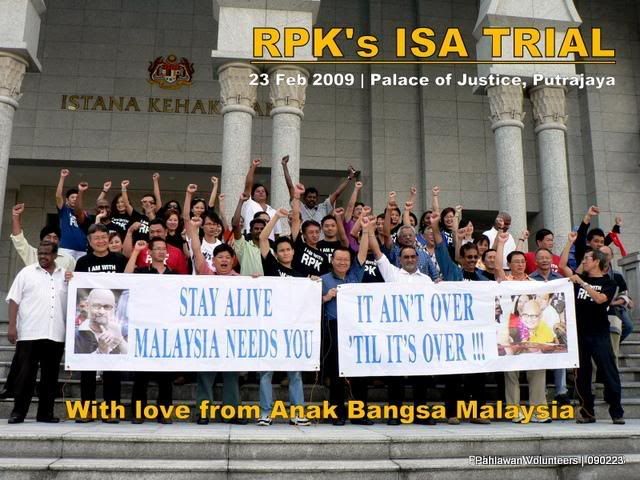
There is a little light in the pitch dark tunnel after all. On behalf of Pahlawan Volunteers and all Anak Bangsa Malaysia, I thank the Registry of the Federal Court for their assistance in fixing the RPK application on an urgent basis.

Counsel Malik Imtiaz and team filed their application last Friday afternoon and were immediately given a date for the hearing i.e. Monday morning.

We are also grateful to the bench for a fair hearing and for giving ample time and latitude for both parties to make their arguments.

Watch Video: Counsel Malik Imtiaz on RPK's Court Review Hearing

To the members of the bench, please take your time to make the judgment. We will continue to pray that God gives you the wisdom and the clarity to make the right judgment for the sake of our homeland and generations to come.

Frankly, we pray you acquit RPK of all charges hurled at him as soon as possible so that we can all focus and work together to build a better Malaysia at a much faster pace (instead of wasting time attending court hearings). We really have no time to lose.

Deep down in all our hearts we know Raja Petra is no “threat to national security” as perceived by the Home Ministry. We pray that our political leaders, wannabes and authorities emulate RPK instead.

Here is a song, dedicated to the judges, lawyers and Anak Bangsa Malaysia:
Be Strong and Take Courage.

And to our beloved mentor Raja Petra Kamarudin, this picture says it all. View more photos here.

court


Continue to pray for Divine Intervention. It Aint Over ‘Til It’s Over.

More Stories and Photos Here:
– Shanghai Fish: Pete's habeas corpus hearing-(23-2-2009)
– DelCapo: RPK ISA Trial Putrajaya - Positives
– Art Harun: A Question of Etiquette
– Malik Imtiaz: Serving Justice, Straight Up

___________________________________________________________
PAT LU, Co-Founder, Pahlawan Volunteers, a Malaysian Voluntary and Advocacy Group.
Join Pahlawan Volunteers Group at Facebook.
Anti-ISA PJ Vigils Video Archive

Monday, February 23, 2009

RPK’s habeas corpus : Reporting live from Putrajaya on 23/2/2009


11.18am : Still at the Bar Room.

Malik Imtiaz has just been informed by the Registrar of the Federal court that the three judges have indicated that they will be reserving their judgment, to be delivered on another date to be fixed later. They have said that they will write up their judgments.

That means no decision today on the motions to review the dismissal of RPK’s 4 motions last week, including the dismissal of the motion to recuse Augustine Paul.

Have also been informed that the hearing of the appeal proper in court room 2 will also not proceed.

RPK will continue to remain free.

10.57am : Reporting from the Bar Room on the ground floor.

At 10.45am, the three judges retired to the ante room to consider submissions. We were told that the court would resume in about half an hour.

Earlier, at about 10.30am, Tun Majid commenced his submissions to oppose the review applications. He relied heavily on an earlier decision of the Court of Appeal, the case of Wan Khairani, in which Richard Malanjum, Tengku Baharuddin and Augustine Paul had sat. That case, too , involved the question as to whether two judges could have sat to hear an application for injunctive relief. Richard and Tengku, who formed the majority in that case, answered in the affirmative. Augustine dissented.

Malik, in his reply, distinguished Wan Khairani with the present case. There, he pointed out, the relevant statutory provision would have allowed one judge to sit and hear the application in question. Two judges sitting therefore, would not have impacted on the constitutionality of the proceedings. However, that was not the case here.

10.26am : Imtiaz still submitting on the matter of whether the two judges could have heard and disposed of the recusal application last week.

10.21am : Powerpoints at the bar table are all not functioning. Battery running low. May have to continue later as delayed reporting. Sorry.

10.12am : Malik submits that the dismissal of the recusal application last week was flawed owing to what Malik refers to as ‘corum failure’, when two judges unconstitutionally heard and dismissed the recusal application. Having dismissed the recusal application a dn then inviting Augustine to resume his seat on the corum, the court then was contaminated with the apparent bias of Augustine, which contamination then infected the dismissal of the remaining three motions filed by RPK and which were heard and dismissed last week.

10.00am : Court in session.

Malik informs the court that the decision to dismiss the recusal application last week is the critical review application fixed for hearing this morning. The contention however, is that as Augustine Paul had sat to dismiss all the other three motions last week, those decisions, too, are tainted by the participation of Augustine Paul and are therefore also the subject cof review applications this morning.

Tun Majid, for the Home Minister, presents his preliminary objection, which, in substance, is that these review applications are an abuse of process, bordering on contempt, as it amounts to an attempt to ‘judge-shop’.

The court does not seem to be with Tun Majid and Malik is invited to begin hus submissions.

9.35am : Gallery in court 1 is filled to the brim. Outside, RPK supporters wait for a chance to get in. Inside, we all wait.

9.20am : The legal team is assembled in Federal Court 1 where the motions for orders to review the four motions filed by RPK and heard and dismissed last week, are due to be heard.

Of particular interest is the motion to review the decision last week to dismiss the motion to recuse Augustine Paul.

The corum hearing this morning’s review motions : Richard Malanjum, Ariffin Zakaria and Hashim Yusoff Alauddin Sheriff.

Meanwhile, the corum to hear the appeal proper waits in Federal Court 2. Whether the main appeal will proceed today depends on what happens here in court 1.

search box